
Communication Support Bot: AI and Human-Robot Interaction for Children’s Expressive Communication.
The Communication Support Bot is personal for me. It comes from watching up close how much frustration builds when a child cannot express a basic need and how much of the work of practising communication falls on families between therapy sessions.
Children with expressive communication challenges often struggle to communicate even basic needs such as hunger, thirst, needing help or wanting to play. When a child cannot effectively express themselves, frustration builds not only for the child but also for parents, caregivers and educators trying to understand and respond.
This project explores how Human-Robot Interaction (HRI), Artificial Intelligence (AI) and Computer Vision can be combined to create a practical communication aid that supports children in expressing themselves more independently.
Rather than replacing speech and language therapy, the Communication Support Bot is designed to supplement professional intervention by creating more opportunities for communication practice at home through repetition and everyday interaction.
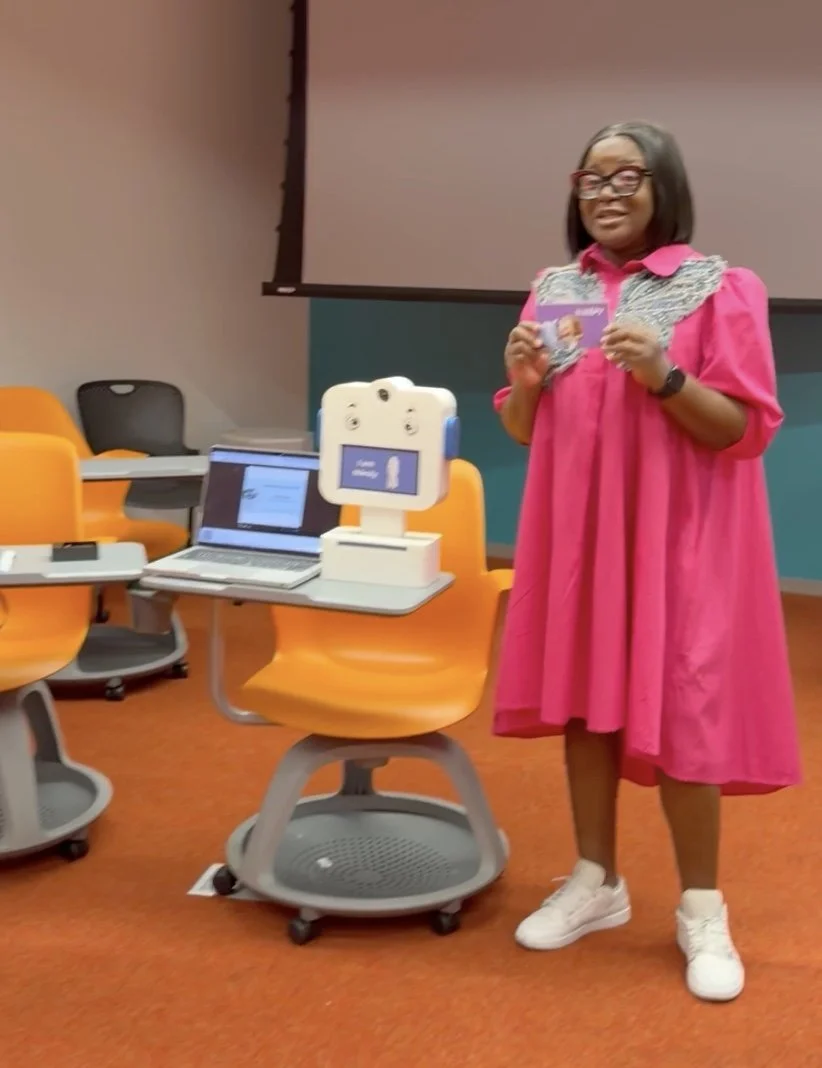
Figure 1. Live classroom demonstration of the Communication Support Bot proof of concept
The Problem
Many children with communication difficulties rely on Alternative and Augmentative Communication (AAC) tools such as picture communication cards or communication boards to express their needs.
While these tools are widely used and effective, they ofter depend on another person interpreting the child’s selection. Therapy sessions with Speech and Language Pathologists are also limited in duration and many families face long waiting lists before accessing services. As a result, much of the child’s communication practice happens at home.
However, parents and caregivers are already balancing work, family responsibilities, appointments and daily life. Consistently reinforcing communication skills can therefore become difficult despite the best intentions.
This inspired the central question behind my project:
How can technology provide additional opportunities for children to practise expressive communication in a simple, engaging and accessible way?
Project Goal
The vision of this project was to develop a proof of concept Communication Support Bot capable of recognising printed communication cards using Artificial Intelligence and Computer Vision.
When a child presents a communication card to the robot, the system recognises the image and immediately displays the corresponding communication phrase on screen.
For example, when the child presents the “Thirsty” card, the display shows:
I am thirsty.
This immediate visual reinforcement helps strengthen the connection between the picture, the written words and the child’s intended message.
The robot also speaks the phrase aloud using audio recordings created during the prototype. In future versions, these recordings could be personalised using the voice of the child’s parent or primary caregiver.
Why This Matters
Children learn through repetition.
Although professional therapy provides essential support, weekly sessions alone are rarely sufficient for developing expressive communication skills. Daily practice is equally important.
The Communication Support Bot is intended to become a supportive home based learning companion that encourages repeated communication practice in a fun and engaging way.
Since the interaction is simple and immediate, children can independently explore communication while caregivers receive additional support during everyday routines.
Design Concept
The Communication Support Bot was designed to resemble a friendly companion rather than a traditional computer or tablet.
The physical prototype consists of a 3D printed robot housing designed as a proof of concept.
To demonstrate the intended design within the project timeframe, printed stickers were used to represent the major hardware components, including:
Camera
Display screen
Speaker
Communication card slot
Although the internal electronics have not yet been integrated, the prototype successfully communicates the intended size, appearance and interaction style of the final robot.
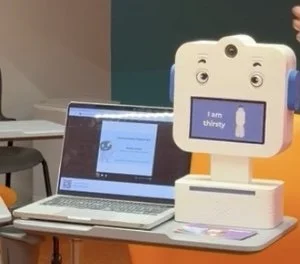
Figure 2. Working proof of concept showing the 3D printed robot prototype alongside the AI powered image recognition system.
Technologies Used
The project combines several technologies across Human Robot Interaction and Artificial Intelligence.
Custom Fabrication. A 3D printed robot enclosure was produced to demonstrate the intended physical form of the Communication Support Bot. This provided a tangible proof of concept while allowing future hardware integration.
Artificial Intelligence and Computer Vision. Google Teachable Machine was used to train an AI image recognition model capable of recognising individual printed communication cards. Training images were collected for each communication card before building and testing the classifier. A “Ready to Help” default screen was also created so that when no communication card is detected, the robot remains in an Idle state waiting for interaction.
Visual Communication. Once a communication card is recognised, the system immediately displays the associated communication phrase. Examples include: I am thirsty. I am hungry. I need the bathroom. I am sleepy. I am hurt. It’s too loud. This visual feedback reinforces expressive language while helping children associate pictures with written communication.
Audio Feedback. Unlike traditional communication boards that rely solely on visual cues, the Communication Support Bot also provides audio feedback to reinforce expressive language. Each communication card was linked to a corresponding spoken phrase recorded in my own voice. When the AI successfully recognised a communication card, the system automatically displayed the communication message on the screen and played the matching audio recording.
This multimodal approach allows children to simultaneously are rhe communciation phrase, hear the spoken words and associate them with the communication card, providing additional opportunities for expressive language development through repetition.
In future revisions, these recordings could be replaced with the voice of the child’s parent or primary caregiver.
Development Journey
Like many engineering projects, the Communication Support Bot evolved throughout development.
The original concept aimed to build a fully integrated robot containing a Raspberry Pi, camera, display, speaker and AI processing capabilities.
As the project progressed, it became clear that validating the interaction itself was more important than completing every hardware component within 3-4 weeks.
The project therefore pivoted toward demonstrating the core Human-Robot interaction using AI based image recognition running on a laptop while the 3D printed robot represented the intended physical platform.
This iterative approach allowed the essential user interaction to be demonstrated while establishing a clear pathway for future development.
Demonstration
The completed proof of concept was demonstrated live during the Human Robot Interaction project presentation.
During the live demonstration:
Printed communication cards were recognised using AI powered Computer Vision.
The corresponding communication phrase appeared immediately on screen and the recorded audio message was automatically played, providing simultaneous visual and auditory feedback.
The 3D printed prototype demonstrated the intended physical design.
The default “Ready to Help” display appeared when no communication card was detected making the interaction feel more natural.
The demonstration successfully illustrated how Custom Fabrication, Computer Vision, Artificial Intelligence, Visual Output and Audio Output can be integrated into an assistive communication system for children with speech and language communication difficulties.
Challenges
Several challenges were encountered throughout development, including learning new Artificial Intelligence tools, training reliable image recognition models, designing communication cards suitable for Computer Vision that could be consistently recognised under different lighting conditions, simplifying the design while preserving the project’s core functionality and balancing ambitious project goals within a limited timeline.
These challenges reinforced the importance of iterative design and validated the value of building and testing a working proof of concept before moving to full implementation.
Future Development
The Communication Support Bot represents the beginning of a much larger vision.
Future development will include Raspberry Pi integration to replace the laptop, an embedded camera, integrated display built in speaker, parent or caregiver voice recordings for personalised audio feedback, expanded communication vocabulary, therapist configuration tools, personalised communication profiles and clinical testing with children, parents and Speech-Language pathologists, as well as other required experts.
The immediate next phase is testing recognition reliability across different distances, lighting conditions and card handling, before any hardware integration.
The long term goal is to create an affordable assistive communication device that complements professional speech and language therapy while providing children and families with additional opportunities to practise expressive communication at home.
Reflection
This project has been of the most personally meaningful projects I have undertaken.
As a Human-Robot Interaction student, I wanted to explore how technology could address a real communication challenge faced by many families.
While the current prototype represents an early proof of concept, it demonstrates how Artificial Intelligence, Computer Vision and Human-Robot interaction can work together to support children with expressive communication difficulties in a practical and engaging way.
More importantly, it reinforced an important principle;
Technology should empower people rather than replace them.
Presenting the project in class and receiving feedback from my instructor and classmates reinforced that beginning with a working proof of concept was the right decision. Demonstrating the core interaction first has provided a solid foundation for future development into a fully integrated standalone assistive robot.
The Communication Support Bot is not intended to replace Speech-Language Pathologists or other professionals. Instead, it aims to become another supportive tool that encourages consistent communication practice beyond the therapy room, providing children with additional opportunities to practise expressive communication through repetition during everyday activities.
Looking ahead, I hope to continue developing this project by collaborating with therapists, educators, engineers and families to refine the concept into a practice assistive technology solution that can positively impact children’s communication and family wellbeing.
Acknowledgements
I would like to express my sincere gratitude to Professor Rob Blain for his guidance, encouragement and constructive feedback throughout the development of this project.
This project was developed in DG8114 Human-Robot Interaction, Master of Digital Media, Toronto Metropolitan University, 2026.
